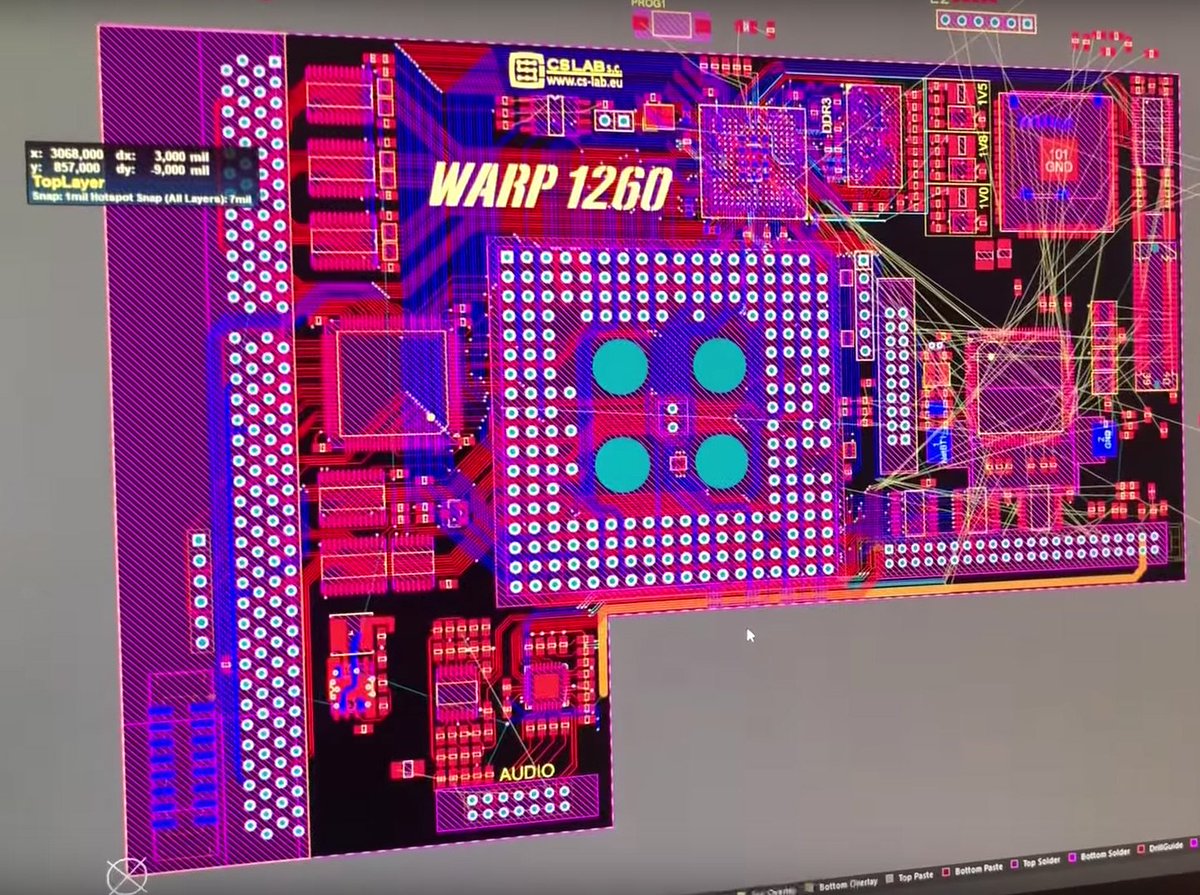
In case you've missed it: A new graphics card for the PCMCIA slot is soon to be released.
The original information seems to date back to the Amiga 40 event in Germany, and was amplified by Amiga Bill when he put it on his YouTube channel in Oct. 2025, but some updates have been coming in over the past few weeks.
Some information has been published on various websites (see links below), and in an interview in "WhatIFF?" magazine Issue 5.19 (April 2026) (see links below), Oliver gives a couple more details about the design. The P-Vision is a PCMCIA device, thus it works with an Amiga 600 or 1200. A 68020 CPU and some FastMEM is required, though. It's a RTG graphics card with HDMI output, providing up to FullHD graphics resolution in 32-bit, equipped with a 64-bit blitter capable of ~320M pixels/s. The driver for P96 (Picasso96) RTG system is developed by Thomas Richter. ("...smooth, buttery screen dragging..." - O. Achten, "WhatIFF?")
Some of the specifications seem to be preliminary, full details are planned to be revealed at ARC #4. (Based on the information currently available it's not entirely clear what sort of sound support the device might have.)
It will be distributed by Alinea Computer (amiga-shop.net), but it's an open-hardware project aiming for affordability and simplicity of design, which means you can also build one yourself. The information required to do so is planned to be released after some months of commercial sales. The cost of building one is estimated at around 100 EUR.
Great stuff! The PCMCIA slot is the best i/o port the Amiga ever had, and it needs more love than just a CompactFlash card adapter. P-Vision certainly makes great use of the PCMCIA slot, and is an outstanding addition to the sadly very short list of Amiga PCMCIA devices.
As a sidenote: In the "WhatIFF?" interview, Oliver also reveals that he is working on "AmiGUS mini" soundcard for PCMCIA, and "Demon 1260" 68060 accelerator for Amiga 1200, among some other things.
On July 17th 2022, Beth Richard, lead engineer of the CD1200 in 1993/1994, visited the Retro Computer Museum in Leicester, UK, making more history and providing invaluable information by talking about her experience, and actually taking the device apart.
A video of the event was uploaded to YouTube about a month ago.
Here's the video of Beth Richard taking the (presumably) only Amiga CD1200 in existence apart (on YouTube channel "PixelFix"):
https://www.youtube.com/watch?v=GYGhOuIysVU
Shortly after the video was uploaded to YouTube, Ms. Richard left a comment which provides even more insight into the background of the CD1200 (transcript of comment follows).
Ms. Richard's comment on the above video (source: https://www.youtube.com/watch?v=GYGhOuIysVU)
"That was quite an experience! I'm so glad we got to do that.
People look back at my work and assume that as the lead engineer, I was somehow a Commodore "Legend". I'll leave that to those to whom it really applies. I was a junior engineer at the time, near the beginning of my career. I think the best way I can describe how I ended up being the lead engineer on this project is a quote taken from Any Weir's "The Martian": "Ares 3. Well, that was my mission. Okay, not mine per se. Commander Lewi was in charge. I was the lowest ranked member of the crew. I would only be 'in command' of the mission if I were the only remaining person.What do you know? I'm in command."It was very clear by the time I started this project that the end was near. I worked on this at a time where we thought it may be possible that someone would buy the company and take it seriously. Having demonstrated that there were ideas and projects with a roadmap into the future would be what someone would want to buy. Several of us were working right to the end to keep a portfolio of projects that could be turned on immediately, should a new owner wish it. (Like the work Dave Haynie was doing at the high end, and some stuff Greg Berlin had been doing too.). It was not to be.
I'm so embarrassed about misspeaking that the date of Pearl Harbor was 7-Dec-1943... ***1941***!!!! I know that! How could my mind have been so bounced and distracted that I would have gotten that wrong? I might have had an excess of adrenaline at the time.
Although I designed that in 1993-1994, I was particularly nervous about opening it because it isn't mine... it's the RCM's. And it's got to be the only example left in the world by this point. I offered to coach Andy through opening it as it's his museum's property, but he wouldn't have it. Sadly, in order to make it work, it needs the controller board to go into the A1200 and cable that came through the port on the rear of the A1200 to connect it to the drive. None of those seem to have survived.
I know it was edited for privacy reasons, but when I was going through the names I saw on the PCB, I started with the first one on the list... mine. The names were actually the userIDs for our email addresses, each of which ended with @ 'cbmvax.commodore.com'. And the word preceding that cut was my userID: brichard. Since that email has been invalid since April 1994, I'm not terribly worried about people knowing it.
And credit where credit is due: My spouse, Teresa, who has her degree in Engineering Management that included nearly the complete curriculum of Mechanical Engineering took a look at the lid spring and noticed the extra bend that was causing it to pop out of position. When she showed it to me, I recognized that the spring was not actually the original factory spring. It must have been broken at some point and someone replaced it by bending a bit of spring-steel wire to (nearly) match. In fact, that mechanism was not custom to the CD1200 - it was re-used from the CD32. So by comparing with a CD32 lid spring mechanism, we confirmed it was wrong and replaced the spring with one from a CD32. The lid works correctly again!
Such a great day! Thank to Andy for inviting me to the RCM and being so gracious about the experience."
(transcript of@bethteresarichard3910's comment on https://www.youtube.com/watch?v=GYGhOuIysVU)
Great work by Ms. Richard, Retro Computer Museum, and all others involved! Thanks for sharing, and keeping the CD1200 alive.
Autofire! Another round of catching up with Amiga game development.
Inviyya II : Hyperblaster
Great shoot-em-up game "Inviyya" by Tigerskunk is about to get a sequel: "Inviyya II: Hyperblaster" was announced in the first half of 2022, and updates on development progress have been posted on the internet since.
"Hyperblaster" looks even better than its prequel, and interestingly a NeoGeo port is in the works, too. So far there's no sound in the Amiga version, but according to the author's YouTube channel, sound has just been added to the NeoGeo port - maybe the one we'll soon hear in the Amiga (CD32) version? Check out Tigerskunk's videos for more "Hyperblaster" previews!
Erik "Earok" Hogan is working on an Amiga port of 1985 arcade game "Gun.Smoke", which is a vertically scrolling shoot-em-up similar to "Commando", but western-style.
"Gun.Smoke" is one of the arcade titles that got ported to a lot of consoles and 8-bit platforms, but strangely never to the Amiga. Well, obviously this is about to change. The upcoming Amiga port is in early development stage, but a video posted on Twitter looks very promising.
Even deeper into the depths of retro computer gaming: The year is 1977, Gremlin Industries (later to become part of SEGA) releases "Depthcharge" to the arcades. It's quite a simple, but also quite an enjoyable game that wasn't the biggest hit ever, but good enough to produce a lot of clones and remakes for numerous platforms.
Fast-forward to 1994: An Amiga version of "Depthcharge" is released as pd/freeware. It looks beautiful, but different from the arcade version.
Fast-forward again to 2022: "Depthcharge" is being remade by AcidBottle. At version 0.2 it's far from finished, but it already plays nicely, and captures the feeling of the arcade original near-perfectly...
So Pacman has a strategist brother that goes by the name of "Blockman". Nice. In this cute, slightly trippy game Blockman has to find a well-thought-out path through several mazes filled with pills, making sure he gets enough of them.
Not only does that sound tasty, it's also addictive.
Finally for this issue, we have yet another neat little game by highly productive developer Jayenkai. "Flappadiddle", released in the second quarter of 2022, puts you in control of Flappy, a tiny yellow bird that has to avoid various obstacles on his way to the target platform, which transports him to the next level. The only protection he has are his flying abilities, and some intermediate landing platforms.
So "Flappy Bird" meets "Space Taxi", kind of. It's a quick'n'clean production - graphics are simple but effective, sound is loud and quirky, it plays flawlessly, and the idea is a little stroke of genius. Great low-fi stuff!
OMG, it's been a long time since the previous issue - again we have a lot of catching up ahead: Huge names in this issue! First-person-shooters, arcade, movie tie-in!
New "Duke Nukem 3D" ports
This game certainly needs little introduction - "Duke Nukem 3D" set a new standard for first-person-shooter games for grown ups (and maybe not so grown ups). In the first half of 2022 two new Amiga ports surfaced.
One is "jfduke3d", which seems to be the slightly less resource-hungry of the two ports, and the other is an update of "AmiDuke". Both require a 68060 CPU, additional RAM, AGA chipset or RTG card, and some files from the original PC game. "AmiDuke" also requires AHI, and "jfduke3d" has TCP/IP multiplayer support (AmiTCP, Miami, Genesis, ...). See links below for more information.
Very much like "Duke Nukem 3D", notorious first-person-shooter pioneer "Wolfenstein 3D: Spear of Destiny" has many incarnations and needs little introduction. Also much like "Duke...", two new ports for the Amiga have been released early this year.
AmiSpear Previously "AmiSpear" required an RTG card, now it's available for ECS and AGA equipped Amigas, too.
spear4amiga Just a couple of weeks later another great new port appeared on AmiNet, it's called "spear4amiga". This one seems to have the lowest system requirements: according to the AmiNet-readme, it runs on an unexpanded Amiga 1200. A little more horsepower is recommended, though.
Both ports require some game data files from the original PC version. See links below for more information.
"Spear of Destiny" in-game screenshot
You can download "AmiSpear" and "spear4amiga" from AmiNet:
Additional sources: http://eab.abime.net/showthread.php?t=109873 (wolf4amiga / spear4amiga forum thread)
Yoomp!
"Yoomp!" might not be as well known as "Duke Nukem 3D" or "Wolfenstein", but it's still a big name: the game was created for the Atari XL, ported to Commodore 64, and there's a spin-off called "Jump!" for AGA Amigas that has certainly raised some eyebrows.
In Jan. 2022 a teaser of the original game of "Yoomp!" for OCS Amigas with 512KB RAM expansion was published. It looks a bit more retro than "Jump!" does on AGA, but it certainly doesn't fail to deliver on groovy music and colorful ball bouncing, eye popping arcade fun. A release date hasn't been set yet.
SEGA's original "Wonder Boy" from 1986 is a great jump-and-run (or skate) arcade game that was a bit of a hype when it was converted for home computers around 1987, and it got a lot of positive reviews. Finally, only about 35 years late, it looks as if we get to play it on our Amigas.
Developer "acidbottle" is working on a remake, and the latest preview video gives the impression that it's close to completion. "Wonderboy 1200" looks and sounds just as enjoyable as the arcade original - if you're into tomahawk-wielding toddlers, snakes, spiders, humongous eggs, and skateboarding, then it's the perfect game for you!
Here's the latest preview video from Acidbottle 0101's YouTube channel (2022-07-13):
https://www.youtube.com/watch?v=iy2FRhnU6tE
Go to the game's website for more information and downloads:
Daniel Allsopp is working on an AGA remake of 1988 arcade game "RoboCop" since 2021, and has been posting "development diary update" videos on YouTube, the latest of which is just a couple of days old.
In stark contrast to the 1989 "RoboCop" game by Ocean, his remake looks totally AGA, and almost identical to the arcade original. No release date has been set yet, but if you watch a couple of Daniel's videos you'll see that a lot of work has already been done, and this is going to be a quality product. Awesome!
Having invested some time on getting a graphics tablet running, and equipped with a now 68040@40MHz driven Amiga, the deadline of the Amiga Art Contest 2020 by Douglas from 10 Minute Amiga Retro Cast (10MARC) and Pixel Vixen popped up somewhere, and pretty much from out of nowhere I started painting...
The graphics tablet is a "Lifetec" branded Tevion/Aldi LT 9310, powered by a homegrown floppy-port-PSU, and connected to the Amiga 1200's internal serial port at 19200 baud and 200lpi, using FormAldiHyd driver from AmiNet.
FormAldiHyd requires MUI, which makes it look a bit nicer than if GadToolsBox had been used, and probably saves the author some typing, but ultimately it's an unneccessary dependency. Anyway, FormAldiHyd hooks into AmigsOS's input handler system, thus is more or less application independent.
PersonalPaint 7 was chosen as the paint program - it's quite fast, straightforward, and system friendly. Basically what I wanted is just some software that's able to properly set pixels on screen according to my hand's movements. 640x512 hires interlaced is my preferred screenmode, and you cannot be
more Amiga than a 32 color picture - this will be the artwork's
geometry.
Work-in-progress, using graphics tablet and mouse
The tablet works! But over hours of painting it turns out you need some strong nerves to keep going despite all the hiccups. Practice makes a huge difference, once you get an intuitive idea about the graphics tablet's dimensions and haptics - both it's overall physical features, and it's drawing area - and the speed the system is able to handle, you can make really good progress, but the tablet becomes unresponsive from time to time, or stutters badly - resulting in interruptions in workflow, and sometimes random dots and lines in the drawing area. (PersonalPaint's multi-undo is very helpful here.) I wasn't able to identify the bottleneck, experimented with FormAldiHyd's settings, New8n1.device as a replacement for AmigaOS's serial port driver, etc. Most times just touching (moving) the mouse would re-enable graphics
tablet input, but at some point I kind of gave up and would keep using
the mouse for a couple of minutes for painting, then give the tablet
another try.
The tablet is still amazing fun to use, and moving a pen is incredibly much faster and smoother than moving a computer mouse with your entire arm. This may affect the results: I ended up using a drawing tool other than pen/airbrush only for the peace symbol, everything else you see in the final result is hand and finger movement. (Ok, maybe the tiger's eye was flooded.)
After three days of occasional painting sessions, I thought from here on it might get worse, so I stopped. When doodling around the first concept that came to my mind was something with a dog - as you can see it turned into a tiger-dog. I had some horror themed ideas, like a Hound of the Baskervilles or so, but then some positive vibe won't do any harm, and the little mouse was created.
'Nuff said - here's the picture:
The final result, as submitted to the Amiga Art Contest 2020
A lot of amazing pictures (and MODs), have been submitted to the Amiga Art Contest 2020, showing there's no shortage of creativity in the community. Tiger and mouse are very proud to be among the contestants. Thanks, 10MARC, Pixel Vixen, and all artists and judges!
My "Frankenstein" Apollo 1240 accelerator needed some decent cooling, so I built something.
The ACT Apollo 1240 is a great accelerator for the A1200, but it requires some extra care. Among the quirks and issues owners of an Amiga 1200 with 68040 or 68060 accelerator have to deal with is heat, especially when using higher- or overclocked CPUs, in a desktop computer case, and when there's no manufacturer supplied cooling mechanism available. The 68040 CPU present on this specimen of the ACT Apollo, with a 80Mhz oscillator, gets unpleasantly hot, so it is likely to become unstable, wear out, and/or damage other components.
To provide some improved cooling to the CPU, a second heatsink was added next to the first one, where previously a 30x30x7mm fan had been positioned. The fan would now require a case and air duct that fits the Apollo 1240 plus a potential 3.3V voltage converter for potential 68060 upgrade, inside the Amiga 1200 desktop case, and direct air towards the CPU and heatsinks in a reasonable way.
Blender 3d modeling fan case
Using Blender I created a 3d model, printed it, refined it, and re-printed it.
(Current) final version in the center
The 3rd incarnation of the model is the (current) final result. The fan more or less rests on three legs inside the case, and has been glued into place with hot glue, sealing off gaps. The case is 3d-printed from PLA at 0.1mm layer height, with spacer sockets on the bottom to leave room for solder and solder pads below, and glued to the Apollo PCB, also using hot glue.
New cooling system with fan, case and heatsinks
First test runs have shown:
a) The cooling effect seems to be pretty strong! From the previous installation with a CPU temperature that's painful to touch ("ouch! burns!"), it went to somewhere hot that still allows sustained finger contact to CPU or heatsink. Certainly a huge improvement.
b) The noise level is easily tolerable. The fan motor is quite audible at times, but there's comparably little hissing from the air moving through the plastic case. Maybe this can
be improved further with a more elaborate shape of the case / air duct.
c) Hot glue is awful because it's somehow neither fish nor flesh, but it's easily removable and makes a very good seal for small gaps in plastic parts. The Apollo 1240 has very few features for extra parts to be be attached to, the CPU might get too hot for direct contact with PLA. Applying and removing hot glue worked very well - at least for development.
b) Overall height, and some space restrictions, are at the borderline. An extra millimeter here and there would be nice - maybe a little cutting and scratching will do, or it's just Amiga case inconsistencies. Otherwise the fan case 3d model might need some modification.
It kind of looks like a mech...
Room has been left for the 68060 voltage converter, but a SCSI connector or second SIMM socket probably won't fit anymore.
One of the heatsinks was already there, so the other one got cut for the 68060 voltage converter "jumpers", red (left of CPU) and white wires are repairs by previous owner
I'll see how the PLA takes the temperature, and if the system remains stable in the long term and under heavy use. Also time will show if hitting the Amiga's keyboard above the cooling system and Apollo board will affect the installation. I guess with lots of warm air around, the new fan case will deform if there's mechanical pressure from one of the other computer components applied to it.
For now I consider it a success, entering "real-life" testing stage - 68040 power at 40Mhz, plus there's a chance this new cooling system will allow a 68060 to be installed on the board. :-)
Another round of looking at 2019's Amiga game development scene.
RESHOOT PROXIMA III Devleaks
Richard "Spieleschreiber" Loewenstein and crew are blowing people's minds with outstanding shoot-em-up games, and the excitement never stops. PROXIMA III is the next episode in Richard's RESHOOT games series, and it's going to be another awesome one. He's released a couple of so-called "Devleaks" videos so far, giving a rough idea of what the end result might look and feel like. Again, as with RESHOOT and RESHOOT R, this will make your eyebrows raise. How PlayStation can you go on Amiga? Be amazed.
Here's Richard "Spieleschreiber" Loewenstein's latest RESHOOT PROXIMA III Devleaks video ("Xmas Update" 2019-12-22):
https://www.youtube.com/watch?v=1SPA9qrflf4
Now this is pretty impressive...!
But... might there be even more to it? In this next video, an earlier "Devleaks" clip, you can see that the game is running in "Amiga 1200 (Blizzard 1260)" emulation, using FS-UAE. Wait a second - are we going full 68060 here? Does this mean this game will go even further and compete with Vampire-levels of performance? With the presumed releases of TF1260 and WARP1260 ahead... is this going to be the killer application that will lead the Amiga into it's next m68k-generation?
https://www.youtube.com/watch?v=5RjYi0riWxE
Subscribe to Spieleschreiber's YouTube channel, and stay up to date!
"Amiga DreamTeam" is working on "Hyperborea", promising the "world's first real Amiga 1200 Danmaku bullet hell classic vertically scrolling shmup game". Not so much is known about the planned game mechanics or level design, and there's no music or effects yet, but, wow, this is a lot of stuff moving around the screen! This very much looks like it's gonna be another envelope-pushing game, with, for example, fast, colorful graphics by using a cleverly designed engine allowing for lots of in-game colors on a low-color screen.
Check out "Hyperborea" latest work-in-progress video below, showing a little bit of menu-action, and a lot of bullets and stuff (2019-10-09):
Inviyya is a horizontal R-Type-type shooter for Amiga 500 (OCS) with 1MB RAM.
Doesn't that alone sound awesome?
A demo has been released over a year ago, but it looks like this classic-style action game is still under heavy development. The latest preview videos (on the game's facebook page, see links below) look increasingly polished, playability seems to be getting tweaked to perfection, and so on. And it has a damn catchy music track.
Here's the latest Inviyya video on YouTube (2019-11-02):
https://www.youtube.com/watch?v=0CpmVtoTPjo
Bleeding-edge updates and previews can be found on Inviyya's facebook page:
This was just a round of shoot-em-ups, but more great Amiga games were under development, or have been released in 2019, such titles as: Rygar AGA,Scourge of the Underkind, andJump! - "Games galore #3", coming soon!
* * *
UPDATE 2020-01-04: The video for Hyperborea wrongly showed "Hyperborea wip #8" (https://www.youtube.com/watch?v=o0mdvi4TY00). This has been corrected to the current one: "Hyperborea wip #%10101" (https://www.youtube.com/watch?v=NRP3d7Zq8WA)
UPDATE 2020-03-08: "Games galore" has turned into a whole series of articles:
It's 196 pages strong, with more than 60 Amiga games reviews, and additional articles covering Amiga models, art on the Amiga, the public domain scene, the best Amiga 1200 games, and "outsider" games.
Being a special issue some of the articles have been published previously, but there are also many new articles, and the majority of pages has been reworked or newly created. New articles include reviews of Alien Breed, Another World, Dune 2, The Great Giana Sisters, The Secret of Monkey Island, Sensible Soccer,
Stunt Car Racer, Wing Commander, Worms, and more.
Retro Gamer "Amiga" special issue costs 14.95EUR, and can be purchased at magazine stores, or online at Heise store.
It very much looks like 2019 will surpass many previous years in number of new games released for the Amiga. In fact it becomes pretty hard to keep up with all the new developments.
RESHOOT R
"RESHOOT" from 2016 by Richard Loewenstein looked awesome, and was kind of something new on Amiga, but Richard isn't done with us yet: now he's given us "RESHOOT R" with more assembler coded action, more bullets, extra weapons, more outlandish looking enemies, more insane sound effects, and more awesome pounding, hypnotizing music. It runs on AGA Amigas (CD32 included), claims to put up to 100 objects on screen at the same time, more than 400 colors, with transparency effects, still parallax-scrolling at 50Hz - no accelerator required, yet runs on 68020 to 68060, taking advantage of additional RAM if present.
Hats off, RESHOOT R rivals "T-Zero" in being the most advanced shoot'em up on the Amiga ever. ESCALATION!
Here's a gameplay video - but beware: this might be a bit of a spoiler!
Better buy the game, start playing, and have your jaw drop as you progress though the levels! It's insanely good!
Not finished yet, but with preview videos out, we can pretty safely assume a 2019 release. "Rygar" is a fantasy themed game for AGA Amigas, a remake of the 1986 Tecmo arcade game. Jump, shoot, dodge, run - somewhere in between "Lionheart", "Shadow of the Beast", and "Ghosts'n'Goblins". It already looks very good, and has some above-average game mechanics. Expect some more improvements and bugfixes, this is gonna be an exciting game.
Inspired by the classic "H.E.R.O." game, "BioJet" is a variation of the fly/dodge/explore genre for all Amigas (with 512KB FastRAM). This looks like a smooth, fun game, and has some interesting technical details (see Aminet readme). Last but not least: it's freeware!
One of the oldest gaming ideas got a massive update with "PONG 4K". You still try to catch and reflect a ball, but that's pretty much where the similarities end. "PONG 4K" is the successor to "PoNG4" - for Amiga CD32 only, has an intro video, CD soundtrack, lots of bleeps and blurps, dark yet colorful graphics, giving it a "Speedball" like dystopian future atmosphere, with parallax scrolling, four players simultaneously, gravity effects, obstacles, ... you name it. Originally released in 2018 it's got a commercial release in 2019. Pong is dead, long live PONG!
Dave May's "AirTaxi" is a 1994 game heavily-inspired by "SpaceTaxi", in fact it looks like a super-polished, enhanced version of the classic. A demo has long been on AmiNet, but recently the full version (.adf) has been released, and even an updated rework is considered by the author. "AirTaxi" can be played by up to 5 human players simultaneously (2 joysticks + 2 joysticks on parallel port + keyboard), and runs smoothly on any Amiga with 1MB ChipRAM and some acceleration (25Mhz). It's got speech, soundfx, obstacles, weather conditions, bad guys, nice little character animations, etc. - this looks very entertaining to play with a couple of friends!
Frank Wille's "Trap Runner" had a "party release" in 2018, but is still going strong in 2019 with an updated "final release", and recently the sourcecode has been released. The game is a "Giana Sisters" type jump-and-run with super cute graphics and sounds, very classic, and it also has the best storyline ever: rescue girl from bad guy. Add playability, intro screens, and of course this irresistable marshmellow-smurf-kindof character - you just can't go wrong with "Trap Runner".
You can buy a physical edition of the game, and you can also try your hands on the sourcecode. It's designed to be portable to other platforms, but there's some assembler code involved.
And we have one more that popped up recently: "Cuba 1898" by Irongate / José A. González P. is a neat sidescrolling jump'n'shoot that puts you right into the Spanish-American war of 1898. Well, kinda. Shoot enemies "Green Beret" style, collect boni - win a war!
The arrival of CD-technology for personal computers caused a huge shift in software development and user experience. The added storage capacity led to a hugely increased amount of content delivered with a software title. Gone were the days of swapping floppy disks, now a single CD could deliver everything required, and much more. CD was everything and everywhere.
Commodore's CDTV, with a built-in CD-ROM drive, was an early attempt, but the underlying original Amiga hardware wouldn't benefit too much from a CD drive, and there was simply not much experience in how to make good use of the CD's extra capabilities. But after the PC and Apple Macintosh market had established the technology and created a demand for added content, it became a must for the Amiga, too. The only Amiga model to make full use of CD-technology is the CD32 console, booting from CD without any additional setup, playing back full motion video and integrating the Amiga's audio with the CD's 16-bit audio tracks.
Wait. The only Amiga model? No. In fact there was another Amiga model that could do the same things, of which nine units were built, and only one is known to still exist today. It's probably the rarest of all (near) market-ready Commodore Amiga developments. It's the legend, the one that should have boosted sales to new heights, potentially saving Commodore from bankruptcy.
It's a CD-ROM drive to be connected to an Amiga 1200, and with a little extra. It has a custom "Data Input" connector, that connects to an expansion board in the Amiga 1200's internal expansion port via cabling routed through the Amiga 1200's backside blanking plate. It also routes Amiga audio signals through, merging them with CD-audio. The expansion board adds a FastRAM SIMM slot, and - in a proposed later model - would have had another custom chip, and room for a 68030 CPU upgrade.
The CD1200 was presented to the public at the CeBIT 1994 show in Han(n)over, Germany. It's goal was to unite and boost Amiga CD32 and Amiga 1200 hardware and
software sales, by being compatible with the former, and adding a CD
drive to the latter.
Now what makes the CD1200 such a rare piece? Well, first of all, according to Beth Richard, lead engineer on the project, only nine prototype units were built.
Eight of them got lost in the turmoil of Commodore's bankruptcy, and only one unit resurfaced. And even that one wasn't instantly recognized as the rarity it is.
Listen to Andy Spencer from the Retro Computer Museum Leicester retell the story of discovering the unique CD1200 in a dusty barn (video by The Centre for Computing History):
https://www.youtube.com/watch?v=VzzMLGcOJik
But the true recognition of the CD1200 came after Ravi Abbot had been visiting the Retro Computer Museum Leicester, and published his video about it in November 2016:
https://www.youtube.com/watch?v=9LmFmH4YNBA
Established YouTuber Dan "kookytech.net" Wood has picked up the subject, and had a more in-depth talk with Andy, and Ex-Commodore UK's David Pleasance. His video of December 2017 covers the unsuccessful search for other CD1200 units still in existence, the rediscovered CD1200's relocation from the back of the museum to a more prominent place, and lots of details from Andy and David:
https://www.youtube.com/watch?v=qYq_F5-fAaw
Would the CD1200 have been able to save Commodore? Well, maybe. In 1994 Sony scored a huge hit with its Playstation console, which has a CD drive, but also offers hardware 3D acceleration and 16-bit 24-channel sound. A CD-drive had become a must-have, but chipset development and platform architecture had also been moving forward rapidly. A CD32, or CD1200-equipped Amiga 1200, wouldn't have been able to compete with PC and console development for a long time, but maybe CD1200 sales, and now-CD32-compatible Amiga 1200 hardware and software sales would've bought Commodore enough time to release the next generation of CD1200 with CPU upgrade, and so on. But it's just speculation.
For Amiga 1200 users it would have been a fantastic addition, with a 68030 CPU on board, especially due to the beautiful design that matches the Amiga 1200 one's. And Amiga CD32 owners would certainly envy the added horsepower, memory, keyboard and i/o-ports.
From todays point of view it would of course just be great to have such a device, in whatever condition or configuration, because it's sooo Commodore Amiga. The fact that there's presumably only this particular one in existence, a rare piece from the last days of Commodore, makes it pretty much the collector's item par excellence. Time will show if maybe another CD1200 exists - maybe it
resurfaces due to the raised interest created by discovering and exposing this one.
In the video by The Centre for Computing History (see above), Andy Spencer says he'd like to open up his CD1200 one day, and maybe, together with the pictures published in magazines, and knowhow from people involved with the project, this will give the insight required to recreate the CD1200 and its expansion board.
Nothing has materialized yet, but who knows, they also said Doom can't be done...
* * *
For your nostalgia-needs, here's another video presenting the CD1200 - note the fake Amiga 1200 case with a built-in CD1200, which is impossible due to CD size, but an intriguing idea:
https://www.youtube.com/watch?v=oydGCxBRL10
Some magazine reports about the Commodore Amiga CD1200:
Apollo team has released an activity report on their forum website, addressing some current issues, like the halted Vampire V2 600 production, as well as ongoing new developments.
Some highlights from their report:
- GOLD 2.7 includes faster IDE, hardware sprites, optimized rewrite of RTG graphics driver, MapROM functionality, hybrid software/hardware FPU, HyperThreading, and more
- GOLD 2.7 core will be available for Vampire V2 500, V2 600, and V4
- GOLD 3 will bring AGA support to OCS/ECS Amigas, and seems to be routing Paula-audio to the HDMI output
- a list of non-Amiga website reports about the Vampire V4, which boldly shows that the outside world does take notice
Judging from the list of new features of the GOLD 2.7 core users can expect a major overall increase in performance.
Especially the Apollo core's current lack of an FPU is a crucial difference to "real" M68k based accelerators (with an FPU), but it looks as these days will soon be gone. It'll be interesting how the other manufacturers of accelerator boards will react to this - namely: phase 5 - as they now have some serious competition when it comes to floating-point number crunching.
Again, Apollo team has given us some spectacular report on their progress. Together with the latest phase 5 announcements this makes 2017 probably the most exciting Amiga year since the turn of the millenium!