AMIGA alive

AMIGA alive

Wednesday, July 26, 2017

Building the TerribleFire TF530r2, Part 2: Obtaining the components

So I've made the descision to try to build a TerribleFire TF530r2 accelerator. The TF530 uses SMD components, which are really small, but the overall number of components is quite low. Based on that, I decided that with good eyesight and accepting some fail-rate it should generally be possible to build the thing.

Disclaimer: This is not an instruction. Use at your own risk. No responsibility taken for whatever you do. Safety first. Kids, dont try this at home. 

Parts and cost


As we know, the docs of the TF530 can be found at: https://github.com/terriblefire/tf530

The readme file contains a BOM (bill of material), of which columns 2 to 4 are relvant for component indentification. It takes some time to get used to specifications and naming. When looking for parts, keep an eye on the "Package" (column 4 of BOM), which in some cases describes the required type (shape/layout/...). Also sometimes you will find out there are variations of components, like for industrial use, made of different material, etc., which are identified by some suffix appended to the name given in the BOM. Finding the matching socket for the 68030 CPU can also be a bit tedious, it has a special layout.

And of course there's the PCB (circuit board) itself, which you can order from dirtypcbs.com: http://dirtypcbs.com/store/details/1330/tf530-rev2b-zip

After hours of searching the internet, I got this impression:
- the PCBs are really cheap
- parts are generally available
- some parts seem to be a bit rare and can only be ordered from one or two retailers
- few parts are cost relevant: CPU, FPU, sockets for CPU and FPU, and SRAM
- the socket / connector to the Amiga's original CPU socket is a critical part that's rare, thus comparably expensive

I decided to go with a 33MHz 68030RP CPU, 40MHz 68882 FPU, and will not use industrial parts, which cost more and are probably more reliable, but I'm assuming there are no extreme temperatures etc. on the TF530. For the 68000-socket connector I'll try to modifiy some other pin connector (2.54mm pin grid).

It turns out that including shipment from different retailers we're still in the "around 100EUR" range for a complete accelerator board, which is an acceptable risk.

So I placed my orders.

Sources


TF530r2 PCB (circuit board) from dirtypcbs.com:
http://dirtypcbs.com/store/details/1330/tf530-rev2b-zip
You probably want to order a "Protopack (+/-10)" which is the cheapest option, and gives you (about? +/-?) 10 boards to play with.

I ordered most of the parts for the TF530r2 from these retailers:
http://www.tme-germany.de
http://www.reichelt.de
http://www.darisus.de
http://www.conrad.de
http://www.mouser.de

68030 CPUs and 68881 or 68882 FPUs are available on eBay.

Additionally, I ordered one or two individual parts via eBay directly from China if there was a good offer.

Special thanks to the very friendly and helpful guy at CONRAD store (Munich, Moosach) who recommended to buy a soldering station and gave lots of information, you're doing a fantastic job


Delivery & Conclusion


The overall time spent on obtaining the parts has to be somewhere around 20hrs, for research, talk, orders, and purchases at local stores. 10 weeks went by from placing the first order to receiving the last one.

Everything arrived properly packaged, and hopefully it's the correct parts... I'll just have to trust them on this. ;-)

Blue TF530r2 PCBs look great, my "protopack (+/-10)" contained ten pieces. On first visual inspection one of them that has a tiny flaw between two IC soldering pads - maybe that's the "Protopack (+/-10)" option? Less quality control than ordering "10" (pieces)? I'll be using that flawed one for some SMD-soldering warm-up practice.

Overall I had one or two issues with the ordering process, but I'm pleasantly surprised how well everything worked, including resolving these issues.

Next time we'll see what we've missed so far, and be doing our first soldering tests - watch out for part 3 of our series "Building the TerribleFire TF530 accelerator board"!

Overview and back catalogue of the series:
http://amigaalive.blogspot.de/p/hardware-building-terribefire-tf530.html

Sunday, July 16, 2017

AMIGA alive 02: M-Tec Mastercard SCSI controller installation (Video)

"AMIGA alive 02 - M-Tec Mastercard SCSI installation" is out! This time we're installing a SCSI controller into our Amiga 1200. Hope you enjoy it, and as always comments are welcome!


https://www.youtube.com/watch?v=OpAuV6Vdl-I


Tuesday, July 11, 2017

"Quasarius" - new oldskool arcade shoot-em-up for the Amiga

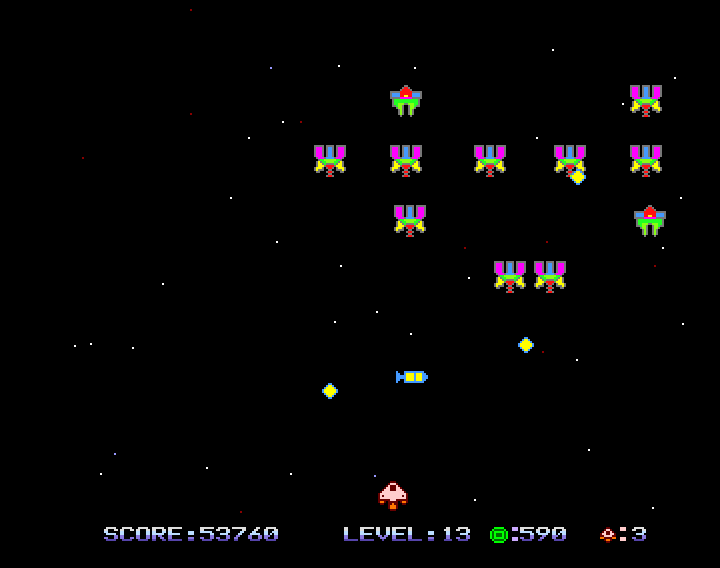
Do you like Space Invaders? Do you adore Deluxe Galaga? Do you remember Phoenix? Then this is the game for you!

https://ralizasoftware.neocities.org/images/quasarius6.png
Collect boni, earn extra ships, get the hi-score - Quasarius is a (very) classic Space Invaders type shoot-em-up game for Amiga by Raliza software. The graphics are simplistic, but perfectly moody, as is the soundtrack. "Quasarius" was written in BlitzBasic by Rafael Lima, with music provided by "Akira". It should run on any Amiga with at least 512KB RAM and OCS or above. (It has been reported that it doesn't run on Kickstart 1.3, though.)

You can download Quasarius for free from:
https://ralizasoftware.neocities.org/amiga.html

It's donationware, so consider making a donation if you like the game, encouraging the authors to continue developing for the Amiga. The developer already announced he's like to do a - probably (very) classic, too - side-scrolling beat-em-up game.

Here you can see Quasarius in action:

https://www.youtube.com/watch?v=C1FTDCHjdB8

Sources:
https://ralizasoftware.neocities.org/amiga.html
http://www.indieretronews.com/2017/06/quasarius-amiga-gets-very-arcade-like.html

Cloanto releases Amiga Forever 7


New features include the ability to autostart the PC into any Amiga configuration, enhanced PowerPC emulation support, custom content folders and playlists, and a "playerless" title playback, preview and editing experience.

As always, "Amiga Forever" probably is the most complete Amiga emulation distribution: includes official Amiga ROMs and operating system, latest versions of WinUAE and WinFellow, applications, games, demos, videos, one-click player interface, ... (depending on "Amiga Forever" version/edition)

https://www.amigaforever.com/gfx/nav/af-170x80-2x.gif


Sources:
https://www.amigaforever.com/
https://www.amigaforever.com/news-events/af-7/

Friday, June 23, 2017

Vampire V2 / Apollo-Core GOLD3 boldy goes AGA chipset emulation!

Here's the next step in Vampire/Apollo-core development, and what an important step it is: Amiga-chipset emulation, namely AGA, is making good progress - now Vampire boards can do AGA graphics and audio via HDMI!

Once again, and finally, it looks like it's really happening: the looooong overdue update of the Amiga's screenmodes and connection capabilities in regard to modern displays.

Additionally, some programs - probably mostly games - will benefit from this new stage of Apollo-core in a specific way: due to not only the super-fast CPU-emulation but also the new AGA-emulation both residing on the Vampire now, there's no need for "turtle mode" anymore - in other words: the CPU doesn't have to wait for the slow Amiga-mainboard chipset blitter anymore, giving huge performance boosts to blitter-heavy applications.

AGA chipset emulation is still work in progress (e.g. currently PAL only), and hasn't been released to the public yet, but you can already watch some impressive demo videos:

Vampire 600 V2 / GOLD3 "No more turtle mode", parts 1 and 2

https://www.youtube.com/watch?v=oYxEFUgWe1o

https://www.youtube.com/watch?v=1Q_rfkqPymg


Source:
http://apollo-core.com/knowledge.php?b=1&note=6563

Wednesday, June 21, 2017

AmiGameJam 2017 game development competition results

The AmiGameJam 2017 Amiga game development competition ran from February 5th to March 30th 2017, and was held in two categories: Classic OCS/AGA Amigas and Next-Gen Amigas (AROS, MorphOS and AmigaOS4). The theme was "TV Shows and Movies" or "Christmas".

Six titles were submitted: Brus Lii, Santa Run (Next-Gen/AmigaOS4), Easter Egg, Max Knight Xmas Edition, Bridge Strike, and The Last Starfighter.

Based on 140 ratings, submissions scored from 1717 to 4720 points.

And the winner is...

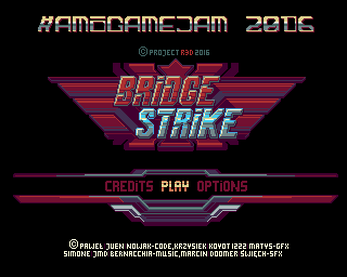
...Bridge Strike, a vertically scrolling shoot'em up.

Project R3D
Code: Pawel Nowak (juen)
Graphics: Krzysztof Matys (koyot1222)
Music: Simone Bernacchia (JMD)
Sound Effects: Marcin Swiech (doomer)

Congratulations!

https://img.itch.zone/aW1hZ2UvMTIzOTQzLzU3MDc5MS5wbmc=/347x500/sHD3hC.png

You can download Bridge Strike, and the other games made for the AmiGameJam at:
https://itch.io/jam/amigamejam/results


Sources:
http://amigamejam.ultimateamiga.co.uk/
https://itch.io/jam/amigamejam

Sunday, June 18, 2017

"Mini Metal Slug" for AmigaOS3 by Arti - and many other games by HunoPPC

Arti has ported "Mini Metal Slug", a "Metal Slug" remake, to AmigaOS3. It's a one-man-army comic-style shoot'em up game, and it demands some serious processing power: 68040 CPU, fast emulator, or Vampire accelerator is required.

You can find it on AmiNet:
http://aminet.net/search?query=minislug

Arti's homepage is:
https://artishq.wordpress.com

The AmigaOS3 version is based on HunoPPC's AmigaOS4 port of the game. HunoPPC has done a lot of other ports, mostly for AmigaOS4, and some for AROS, MorphOS, Linux, MacOS, Windows.

Titles include "World of padman", "Return to Castle Wolfenstein", "OpenBor"
"Xgalaga", "Aliens versus Predator 2000", "Enemy Territory: Legacy", among others.


You can find a list of his projects on his homepage:
http://hunoppc.amiga-projects.net/

Here's a video of "Mini Metal Slug" running on a Vampire accelerated Amiga:


https://www.youtube.com/watch?v=cvBGARLrPEc


Sources:
http://www.apollo-core.com/knowledge.php?b=3&note=6140
http://aminet.net/package/game/actio/MiniSlug
https://artishq.wordpress.com/